 Add to Chrome
 Add to Firefox
 Add to Edge
Face Swapping
Face swapping is the process of replacing one person's face with another person's face in an image or video.
Papers and Code
Beauty and the Beast: Imperceptible Perturbations Against Diffusion-Based Face Swapping via Directional Attribute Editing
Jan 30, 2026
Diffusion-based face swapping achieves state-of-the-art performance, yet it also exacerbates the potential harm of malicious face swapping to violate portraiture right or undermine personal reputation. This has spurred the development of proactive defense methods. However, existing approaches face a core trade-off: large perturbations distort facial structures, while small ones weaken protection effectiveness. To address these issues, we propose FaceDefense, an enhanced proactive defense framework against diffusion-based face swapping. Our method introduces a new diffusion loss to strengthen the defensive efficacy of adversarial examples, and employs a directional facial attribute editing to restore perturbation-induced distortions, thereby enhancing visual imperceptibility. A two-phase alternating optimization strategy is designed to generate final perturbed face images. Extensive experiments show that FaceDefense significantly outperforms existing methods in both imperceptibility and defense effectiveness, achieving a superior trade-off.

APPLE: Attribute-Preserving Pseudo-Labeling for Diffusion-Based Face Swapping
Jan 21, 2026Face swapping aims to transfer the identity of a source face onto a target face while preserving target-specific attributes such as pose, expression, lighting, skin tone, and makeup. However, since real ground truth for face swapping is unavailable, achieving both accurate identity transfer and high-quality attribute preservation remains challenging. In addition, recent diffusion-based approaches attempt to improve visual fidelity through conditional inpainting on masked target images, but the masked condition removes crucial appearance cues of target, resulting in plausible yet misaligned attributes. To address these limitations, we propose APPLE (Attribute-Preserving Pseudo-Labeling), a diffusion-based teacher-student framework that enhances attribute fidelity through attribute-aware pseudo-label supervision. We reformulate face swapping as a conditional deblurring task to more faithfully preserve target-specific attributes such as lighting, skin tone, and makeup. In addition, we introduce an attribute-aware inversion scheme to further improve detailed attribute preservation. Through an elaborate attribute-preserving design for teacher learning, APPLE produces high-quality pseudo triplets that explicitly provide the student with direct face-swapping supervision. Overall, APPLE achieves state-of-the-art performance in terms of attribute preservation and identity transfer, producing more photorealistic and target-faithful results.
AlphaFace: High Fidelity and Real-time Face Swapper Robust to Facial Pose
Jan 23, 2026Existing face-swapping methods often deliver competitive results in constrained settings but exhibit substantial quality degradation when handling extreme facial poses. To improve facial pose robustness, explicit geometric features are applied, but this approach remains problematic since it introduces additional dependencies and increases computational cost. Diffusion-based methods have achieved remarkable results; however, they are impractical for real-time processing. We introduce AlphaFace, which leverages an open-source vision-language model and CLIP image and text embeddings to apply novel visual and textual semantic contrastive losses. AlphaFace enables stronger identity representation and more precise attribute preservation, all while maintaining real-time performance. Comprehensive experiments across FF++, MPIE, and LPFF demonstrate that AlphaFace surpasses state-of-the-art methods in pose-challenging cases. The project is publicly available on `https://github.com/andrewyu90/Alphaface_Official.git'.
Safeguarding Facial Identity against Diffusion-based Face Swapping via Cascading Pathway Disruption
Jan 21, 2026The rapid evolution of diffusion models has democratized face swapping but also raises concerns about privacy and identity security. Existing proactive defenses, often adapted from image editing attacks, prove ineffective in this context. We attribute this failure to an oversight of the structural resilience and the unique static conditional guidance mechanism inherent in face swapping systems. To address this, we propose VoidFace, a systemic defense method that views face swapping as a coupled identity pathway. By injecting perturbations at critical bottlenecks, VoidFace induces cascading disruption throughout the pipeline. Specifically, we first introduce localization disruption and identity erasure to degrade physical regression and semantic embeddings, thereby impairing the accurate modeling of the source face. We then intervene in the generative domain by decoupling attention mechanisms to sever identity injection, and corrupting intermediate diffusion features to prevent the reconstruction of source identity. To ensure visual imperceptibility, we perform adversarial search in the latent manifold, guided by a perceptual adaptive strategy to balance attack potency with image quality. Extensive experiments show that VoidFace outperforms existing defenses across various diffusion-based swapping models, while producing adversarial faces with superior visual quality.
TwoHead-SwinFPN: A Unified DL Architecture for Synthetic Manipulation, Detection and Localization in Identity Documents
Jan 19, 2026The proliferation of sophisticated generative AI models has significantly escalated the threat of synthetic manipulations in identity documents, particularly through face swapping and text inpainting attacks. This paper presents TwoHead-SwinFPN, a unified deep learning architecture that simultaneously performs binary classification and precise localization of manipulated regions in ID documents. Our approach integrates a Swin Transformer backbone with Feature Pyramid Network (FPN) and UNet-style decoder, enhanced with Convolutional Block Attention Module (CBAM) for improved feature representation. The model employs a dual-head architecture for joint optimization of detection and segmentation tasks, utilizing uncertainty-weighted multi-task learning. Extensive experiments on the FantasyIDiap dataset demonstrate superior performance with 84.31\% accuracy, 90.78\% AUC for classification, and 57.24\% mean Dice score for localization. The proposed method achieves an F1-score of 88.61\% for binary classification while maintaining computational efficiency suitable for real-world deployment through FastAPI implementation. Our comprehensive evaluation includes ablation studies, cross-device generalization analysis, and detailed performance assessment across 10 languages and 3 acquisition devices.
DreamID-V:Bridging the Image-to-Video Gap for High-Fidelity Face Swapping via Diffusion Transformer
Jan 04, 2026Video Face Swapping (VFS) requires seamlessly injecting a source identity into a target video while meticulously preserving the original pose, expression, lighting, background, and dynamic information. Existing methods struggle to maintain identity similarity and attribute preservation while preserving temporal consistency. To address the challenge, we propose a comprehensive framework to seamlessly transfer the superiority of Image Face Swapping (IFS) to the video domain. We first introduce a novel data pipeline SyncID-Pipe that pre-trains an Identity-Anchored Video Synthesizer and combines it with IFS models to construct bidirectional ID quadruplets for explicit supervision. Building upon paired data, we propose the first Diffusion Transformer-based framework DreamID-V, employing a core Modality-Aware Conditioning module to discriminatively inject multi-model conditions. Meanwhile, we propose a Synthetic-to-Real Curriculum mechanism and an Identity-Coherence Reinforcement Learning strategy to enhance visual realism and identity consistency under challenging scenarios. To address the issue of limited benchmarks, we introduce IDBench-V, a comprehensive benchmark encompassing diverse scenes. Extensive experiments demonstrate DreamID-V outperforms state-of-the-art methods and further exhibits exceptional versatility, which can be seamlessly adapted to various swap-related tasks.
BLANKET: Anonymizing Faces in Infant Video Recordings
Dec 17, 2025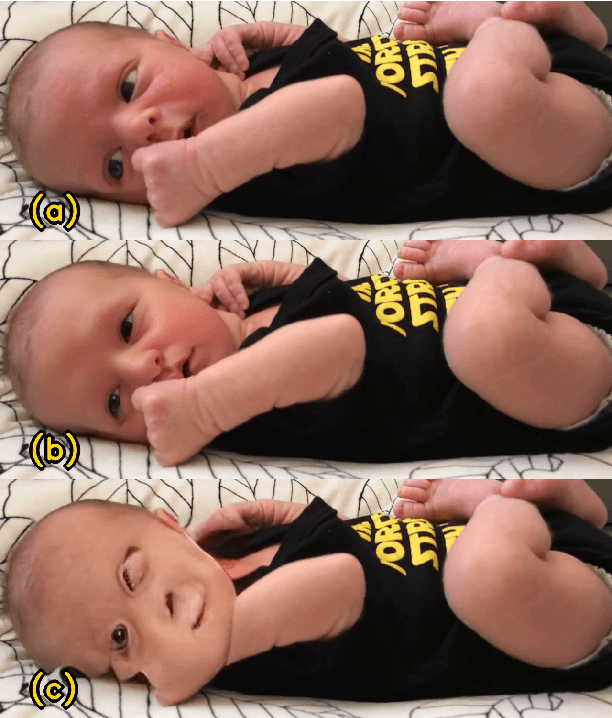
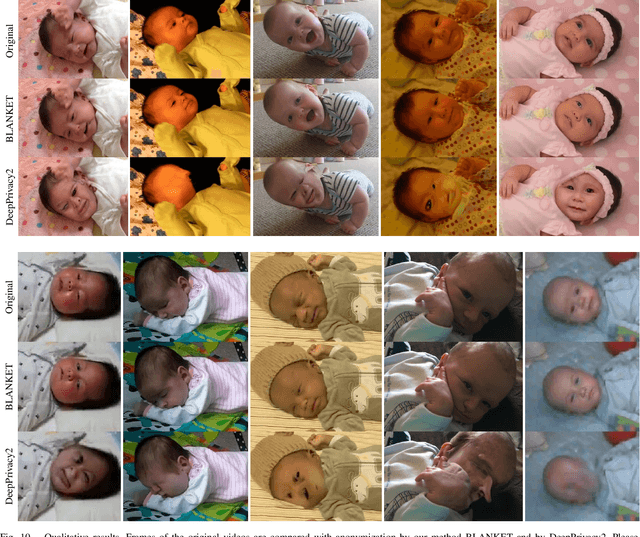
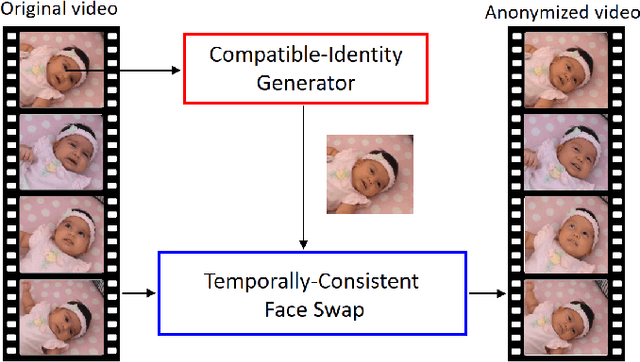
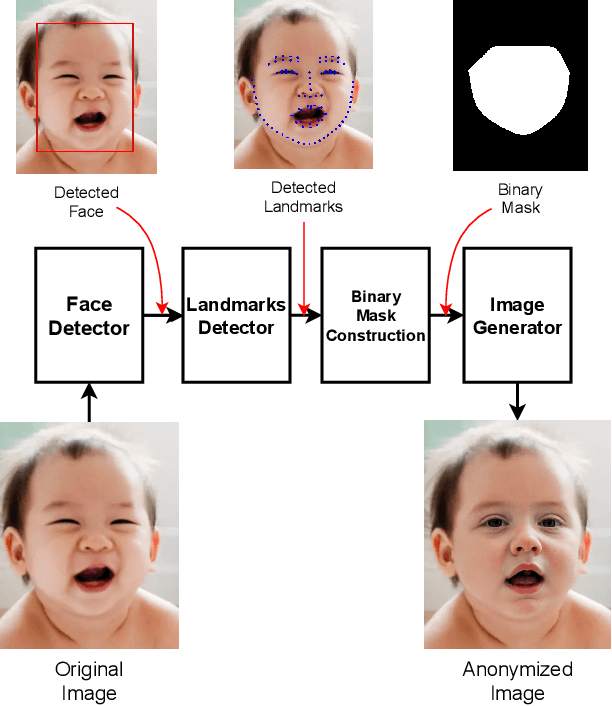
Ensuring the ethical use of video data involving human subjects, particularly infants, requires robust anonymization methods. We propose BLANKET (Baby-face Landmark-preserving ANonymization with Keypoint dEtection consisTency), a novel approach designed to anonymize infant faces in video recordings while preserving essential facial attributes. Our method comprises two stages. First, a new random face, compatible with the original identity, is generated via inpainting using a diffusion model. Second, the new identity is seamlessly incorporated into each video frame through temporally consistent face swapping with authentic expression transfer. The method is evaluated on a dataset of short video recordings of babies and is compared to the popular anonymization method, DeepPrivacy2. Key metrics assessed include the level of de-identification, preservation of facial attributes, impact on human pose estimation (as an example of a downstream task), and presence of artifacts. Both methods alter the identity, and our method outperforms DeepPrivacy2 in all other respects. The code is available as an easy-to-use anonymization demo at https://github.com/ctu-vras/blanket-infant-face-anonym.
* Project website: https://github.com/ctu-vras/blanket-infant-face-anonym
Decentralized No-Regret Frequency-Time Scheduling for FMCW Radar Interference Avoidance
Dec 31, 2025Automotive FMCW radars are indispensable to modern ADAS and autonomous-driving systems, but their increasing density has intensified the risk of mutual interference. Existing mitigation techniques, including reactive receiver-side suppression, proactive waveform design, and cooperative scheduling, often face limitations in scalability, reliance on side-channel communication, or degradation of range-Doppler resolution. Building on our earlier work on decentralized Frequency-Domain No-Regret hopping, this paper introduces a unified time-frequency game-theoretic framework that enables radars to adapt across both spectral and temporal resources. We formulate the interference-avoidance problem as a repeated anti-coordination game, in which each radar autonomously updates a mixed strategy over frequency subbands and chirp-level time offsets using regret-minimization dynamics. We show that the proposed Time-Frequency No-Regret Hopping algorithm achieves vanishing external and swap regret, and that the induced empirical play converges to an $\varepsilon$-coarse correlated equilibrium or a correlated equilibrium. Theoretical analysis provides regret bounds in the joint domain, revealing how temporal adaptation implicitly regularizes frequency selection and enhances robustness against asynchronous interference. Numerical experiments with multi-radar scenarios demonstrate substantial improvements in SINR, collision rate, and range-Doppler quality compared with time-frequency random hopping and centralized Nash-based benchmarks.
Preserving Source Video Realism: High-Fidelity Face Swapping for Cinematic Quality
Dec 08, 2025Video face swapping is crucial in film and entertainment production, where achieving high fidelity and temporal consistency over long and complex video sequences remains a significant challenge. Inspired by recent advances in reference-guided image editing, we explore whether rich visual attributes from source videos can be similarly leveraged to enhance both fidelity and temporal coherence in video face swapping. Building on this insight, this work presents LivingSwap, the first video reference guided face swapping model. Our approach employs keyframes as conditioning signals to inject the target identity, enabling flexible and controllable editing. By combining keyframe conditioning with video reference guidance, the model performs temporal stitching to ensure stable identity preservation and high-fidelity reconstruction across long video sequences. To address the scarcity of data for reference-guided training, we construct a paired face-swapping dataset, Face2Face, and further reverse the data pairs to ensure reliable ground-truth supervision. Extensive experiments demonstrate that our method achieves state-of-the-art results, seamlessly integrating the target identity with the source video's expressions, lighting, and motion, while significantly reducing manual effort in production workflows. Project webpage: https://aim-uofa.github.io/LivingSwap
Towards Robust Protective Perturbation against DeepFake Face Swapping
Dec 08, 2025DeepFake face swapping enables highly realistic identity forgeries, posing serious privacy and security risks. A common defence embeds invisible perturbations into images, but these are fragile and often destroyed by basic transformations such as compression or resizing. In this paper, we first conduct a systematic analysis of 30 transformations across six categories and show that protection robustness is highly sensitive to the choice of training transformations, making the standard Expectation over Transformation (EOT) with uniform sampling fundamentally suboptimal. Motivated by this, we propose Expectation Over Learned distribution of Transformation (EOLT), the framework to treat transformation distribution as a learnable component rather than a fixed design choice. Specifically, EOLT employs a policy network that learns to automatically prioritize critical transformations and adaptively generate instance-specific perturbations via reinforcement learning, enabling explicit modeling of defensive bottlenecks while maintaining broad transferability. Extensive experiments demonstrate that our method achieves substantial improvements over state-of-the-art approaches, with 26% higher average robustness and up to 30% gains on challenging transformation categories.